AI Real Estate Marketing When Everyone Uses AI
Published · Updated
AI real estate marketing gives every agent the same advantage: fast, polished copy. That's exactly why it can't be your difference. Use AI to produce and distribute faster, and spend the time you save on what a client can verify: your specialty, your questions and the promises you keep.
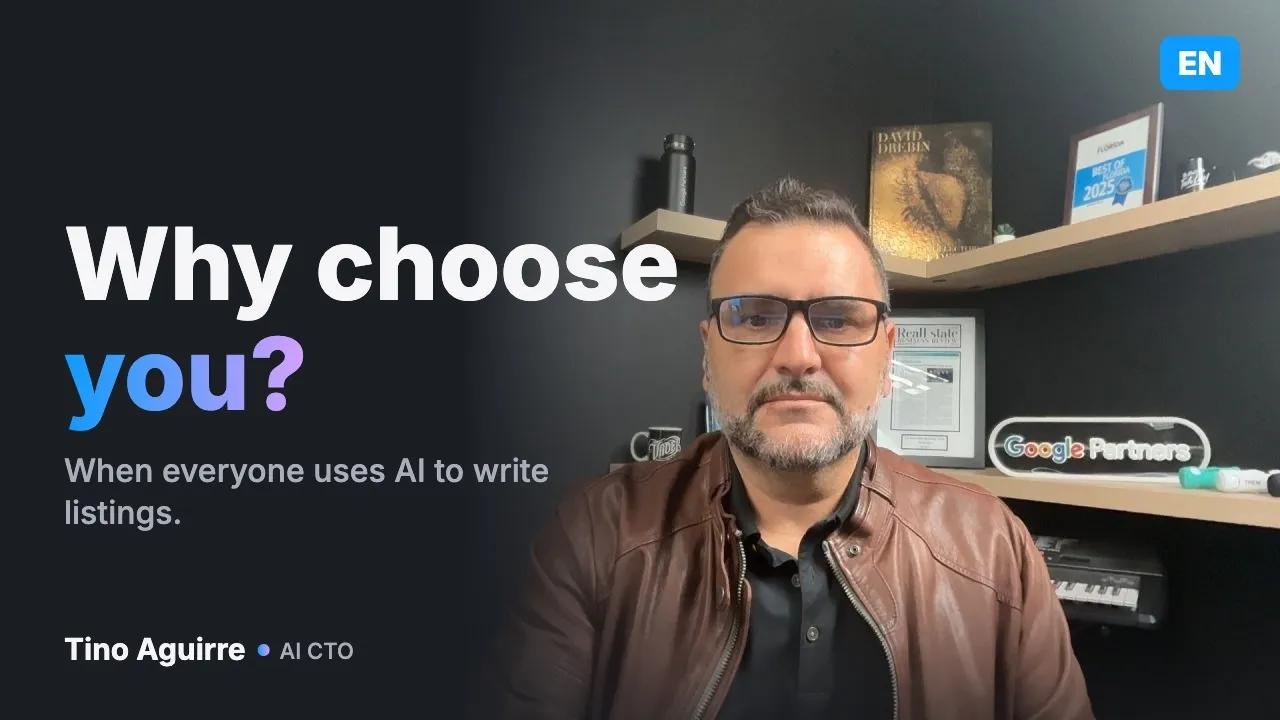
Created with my AI avatar and AI voice, from my own ideas and script. It’s how I publish more, faster.
Video transcript
If every agent uses AI to write perfect listings, why would a client choose you?
I’m Tino Aguirre, AI CTO at TREM Group and IDXBoost. I build AI for real estate and use it every day with my team.
Imagine two agents with the same AI and the same property. Both publish a flawless listing. So far, either one would do.
But next to the building there’s a stadium. One agent highlights the short commute. The other suggests: before you decide, let’s do your route on a game day.
Maybe the client rules out the apartment, or confirms it works. What matters is that they decide knowing it, instead of finding out after moving in.
Your difference lives somewhere else: in a specialty you can prove, in the questions you ask, and in keeping your promises.
So try this test: if tomorrow your competitors could publish exactly the same listing as you, what concrete reason would a client have to choose you?
At IDXBoost we build AI tools so your marketing communicates that difference, instead of just producing more text.
And if you’re a realtor, run a real estate team or own a brokerage, TREM Group is the all-in-one real estate marketing, technology and growth platform for your business.
And my full book is free at tinoaguirre.com/book.
Key takeaways
- When every agent can publish a flawless listing, the listing stops being proof of anything.
- Use AI listing descriptions as a first draft, then add what only you know about the property.
- Publishing more is not the goal; spending smarter on the ads that bring real conversations is.
- Marketing only pays off when attention turns into appointments, so follow-up matters as much as the ad.
Why AI-written listings all sound the same
Imagine two agents with the same AI and the same property. Both publish a flawless listing: clear, well structured, with the right adjectives. So far, either one would do. That’s the problem.
As I ask in chapter 6 of The AI Real Estate Disruption: if we all use AI, why would a client choose me? When every agent can generate polished copy in seconds, polished copy stops being a signal. The book’s test is uncomfortable on purpose: if tomorrow your competitors could generate exactly the same ad, what specific reason would a customer have to keep choosing you?
What AI real estate marketing should do for you
Good AI real estate marketing doesn’t try to make your text better than everyone else’s. It frees your time so your difference can show up somewhere else:
- Versions, languages and formats in minutes. An agent who once spent hours preparing versions, languages or formats can devote more attention to distribution and to the client (chapter 6).
- A consistent presence across your site, portals and social channels without starting from zero each time.
- Budget that follows results, not habit.
- More time for the conversations that turn attention into appointments.
AI listing descriptions: a first draft, not your difference
AI listing descriptions are useful, and you should use them. But as chapter 6 puts it, AI can help you communicate a difference that you have built; a brilliant listing is not enough to demonstrate it.
Go back to the two agents. Next to the building there’s a stadium. One highlights the short commute. The other suggests: before you decide, let’s do your route on a game day. Maybe the client rules out the apartment, or confirms it works. What matters is that they decide knowing it, instead of finding out after moving in. No description generator would have written that second sentence, because it comes from judgment, not from text.
A weekly routine that works
You don’t need a complicated process. A simple routine keeps AI where it helps and your judgment where it counts:
- Draft with AI. Listings, posts and emails for the week, in every version and language you need.
- Check the facts. Size, parking, fees and conditions against the documents, before anything is published.
- Add what only you know. One observation from the showing, one question the buyer should ask, one detail about the street.
- Publish where it brings conversations, not everywhere at once.
- Review appointments, not likes, at the end of the week, and move the budget accordingly.
AI for real estate ads: spend smarter, not louder
The book is direct about the economics: publishing more will not ensure better results; distribution and credibility could matter more (chapter 6). There is also no automatic premium for using AI. An ad written by AI costs the same to show as any other ad.
Where AI does help is in deciding where the money goes. At IDXBoost we build AI Ads Optimizer for exactly that: the ad budget goes to the campaigns that bring real conversations, not just clicks. The question to ask of any ad tool is the same: does it bring more people who write, call and book, or only more impressions?
From clicks to appointments
Marketing ends where follow-up begins, and that’s where many campaigns lose what they paid for. A lead that writes at night and waits until the next afternoon for an answer was expensive attention, wasted.
That’s why AI real estate marketing and follow-up belong together: the ad brings the conversation, and the follow-up makes sure it becomes an appointment. Before spending more on ads, look at what happens to the leads you already get: how fast they hear back, how many book a showing and how many simply go quiet. Fixing that is usually cheaper than buying more attention. If that second part is weak, start there. The guide to AI lead follow-up for real estate covers how to answer every lead and book the appointment without chasing.
For brokerages: one brand, many specialists
In a brokerage, AI real estate marketing creates a new risk: every agent publishing the same polished text, under the same logo, with nothing that tells a client who knows what. The brand looks consistent and the agents become interchangeable.
The better approach is the opposite. Let AI handle the shared part (structure, formats, languages, consistency with the brand) and make each agent’s specialty visible: the neighborhoods they know, the type of client they serve best, the questions they always ask. And put the ad budget behind what brings appointments for the team, not behind whoever publishes the most.
Your difference lives outside the text
The answer I give in the chapter 6 video has nothing to do with copywriting: your difference lives in a specialty you can prove, in the questions you ask and in keeping your promises. Marketing, with or without AI, should make that visible:
- Show your specialty with what you’ve done, not with adjectives.
- Publish the questions you ask before a client decides; they say more about you than any description.
- Keep the promises your ads make. The fastest way to lose the advantage AI gave you is a listing that says more than the property delivers.
For the bigger picture of what AI changes for agents, see the guide to AI for real estate agents.
Frequently asked questions
Should I use AI listing descriptions?
Yes, as a first draft. AI listing descriptions save time on structure, versions and languages. But the draft doesn't know what you saw in the showing: the noise at night, the light in the afternoon, the stadium next door. Add that, check every fact against the documents and make the description sound like you.
How can AI for real estate ads help me spend less?
By putting the budget where it brings conversations, not just clicks. With AI Ads Optimizer, which we build at IDXBoost, the ad budget goes to the campaigns that bring real conversations. The goal is not more impressions; it's more people who actually write, call and book a showing.
Will clients penalize me for using AI in my marketing?
Not for using it; for what it hides. If AI helped you prepare an analysis or a recommendation, say so clearly. And never let a polished text promise something the property doesn't have. Clients don't punish tools; they punish surprises after they move in.
If everyone uses AI, how do I stand out?
With what a competitor can't copy by generating the same text: a specialty you can prove, the questions you ask before the client decides, how fast and honestly you follow up, and the commitments you keep. Your marketing should communicate that difference, not replace it.
What should AI real estate marketing measure?
Appointments, not volume. Track how many people who saw your listing or ad actually wrote, booked a showing and showed up. If AI doubles the number of posts but the appointments stay the same, the marketing isn't working better; it's just louder.
Is it really Tino speaking in the videos?
The ideas, script and final review are Tino’s. The video is produced with his AI avatar, using his own image and voice, to publish more content in English and Spanish, much faster.